


Nebraska: Hey, remember when I warned that the Big Ugly Bill's Medicaid cuts were gonna hit well BEFORE the midterms? Well, guess what...
Mon, 04/27/2026 - 1:57pm
As of June 2025, around 70,000 Nebraska residents were enrolled in Medicaid via the ACA's expansion of the program.
Last summer, after Congressional Republicans passed their Big Ugly Bill, I warned people against assuming that the gutting of Medicaid wouldn't hit until after the 2026 midterms:
Over at The New Republic, Greg Sargent has taken this thinking one step further, noting that by delaying so much of the ugliness of the new law until 2027 or beyond...
Republicans know how unpopular all this will be. So they’ve structured the bill so the tax cuts land immediately, while many of the Medicaid cuts get going in 2027 and 2028. That’s meant to spare them in the midterms.
But there’s a wrinkle here worth appreciating. Those policies will start hitting right when JD Vance’s bid to succeed Trump is getting underway. For Vance—perhaps the most prominent evangelist for Trumpism’s supposed promise for the working class—to have to defend all of that carnage while running for president could yet prove a form of poetic justice.
Again, this is a fair statement, as far as it goes.
However, while I'm not an expert on any of the non-healthcare provisions, when it comes to the sections related to healthcare policy, a whole lot of the ugly will actually hit well before the midterms.
I went on to break out the actual effective date of every healthcare-related provision, including noting that...
IMPORTANT: Even the controversial & much-debated Medicaid work reporting requirements which have sucked up so much political & media attention, which everyone keeps saying "won't be implemented until after the midterms," could potentially go into effect before Election Day 2026 after all.
The actual wording of the relevant legislative text is:
"...the first day of the first quarter that begins after December 31, 2026, or, at the option of the State under a waiver or demonstration project under section 1115 or the State plan, such earlier date as the State may specify."
In other words, some states COULD potentially launch them BEFORE the midterms via a waiver if granted by the HHS Dept.
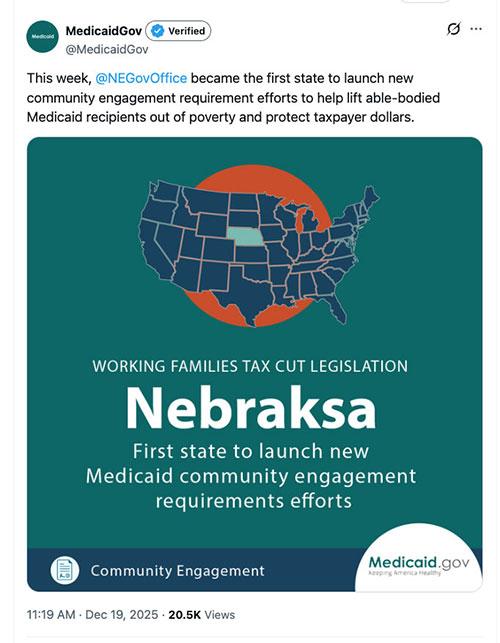
Well, it turns out I was right: As I wrote about back in December, this was a real tweet posted by the U.S. Centers for Medicare & Medicaid Services dept. (CMS), misspelled state name and all, which was left up for at least a week before they got around to deleting it:
The policy is going into effect starting May 1st, 2026...just four days from today.
Here's the official details from the Nebraska Dept. of Health & Human Services.
A couple of weeks back, Alice Miranda Ollstein of Politico wrote a piece about how the state is scrambling to implement the new program ahead of the deadline:
Nebraska is racing to implement Medicaid work requirements by May 1 — eight months before the national deadline set by the One Big Beautiful Bill Act passed by Congress last summer.
And not only is the state first out of the gate, its government plans to do it without hiring any additional staff, even as other state health departments prepare to bring aboard dozens if not hundreds of new employees to determine who should remain enrolled and who should be booted from the safety net health insurance program.
Policy experts and advocates for people on the Medicaid rolls fear the rushed timeline and understaffing will lead to disaster.
“The situation here on the ground is that people are afraid,” said Sarah Maresh, the program director for health care access at the nonprofit Nebraska Appleseed. “The fact that we’re so close to the implementation date and still have no real answers on a bunch of things, along with the lack of investment and resources, are all really concerning to us.”
And the real world consequences?
...Nebraska Appleseed estimates that about two-thirds of the state’s Medicaid expansion population — around 54,000 people — will lose their insurance once the rules and other federal changes to Medicaid are in force, including many people who are working or have a legitimate exemption but can’t navigate the process. Other health policy experts predict a smaller but still seismic impact, with between 16,000 and 30,000 Nebraskans losing insurance coverage.
That would actually amount to between 23% - 77% of the total as of June 2025.
...On May 1, the state will start requiring roughly 72,000 low-income people enrolled in the state’s Medicaid expansion to prove compliance with the new work requirements every six months.
Despite many GOP governors’ enthusiasm for the policy, few states are joining Nebraska in getting a head start. Both Arkansas and Montana are enacting work requirements in July, although Arkansas officials say theirs is merely a “soft launch” and no one will lose coverage until next January.
Nebraska, however, is the sole state to charge forward before the Trump administration releases final guidance for the program in June — information other states say is necessary for deciding how to enforce the rules.
Additionally, the health policy consulting firm Manatt estimated that states need at least 18 to 24 months to set up the necessary IT systems, followed by at least four months of testing to ensure they work — far more time than Nebraska is allowing itself.
...Alker and other experts are particularly worried about states like Nebraska that have large rural populations, which they say are at higher risk of losing coverage for several reasons.
Rural areas have more poor residents who qualify for Medicaid, higher rates of chronic illnesses, fewer jobs, and worse access to the internet. Rural Nebraskans must also travel farther to the government offices where they can figure out their enrollment status.
As a reminder, Nebraska voted for Republican Donald Trump by over 20 points, for Republican Senator Deb Fischer by 7 points, and for Republican House members Mike Flood, Don Bacon and Adrian Smith by 20 points, 2 points and 61 points respectively.
Advertisement


