


Nevada: Effectuated ACA enrollment down over 11% as of May; nearly 12,000 have lost coverage already
Fri, 05/22/2026 - 11:10am
Once again: The true measure of ACA healthcare coverage enrollment isn't how many people select policies during the Open Enrollment Period, it's how many actually have those policies in effect (aka "effectuated enrollment")...as well as how comprehensive that coverage is, of course.
Yesterday, Pluribus News published a new story about effectuated enrollment across a dozen or so states (the reporters actually consulted with me several times about their data and how to present it, although I somehow didn't end up getting credited in the final version).
In any event, most of the material discussed in their story is pretty much everything I've been writing about and warning about for months, and even the enrollment data they acquired is the same as what I have in most cases. They were, however, able to get ahold of hard effectuation numbers for three states which I didn't already know: Arkansas, Nevada and Vermont.
With that in mind, here's what Nevada's enrollment looks like as of May compared compared with the official CMS monthly effectuated reports from prior years. It's important to note that the Pluribus story only has the effectuated number for May, so I'm assuming it was proportionately similar for January - April:
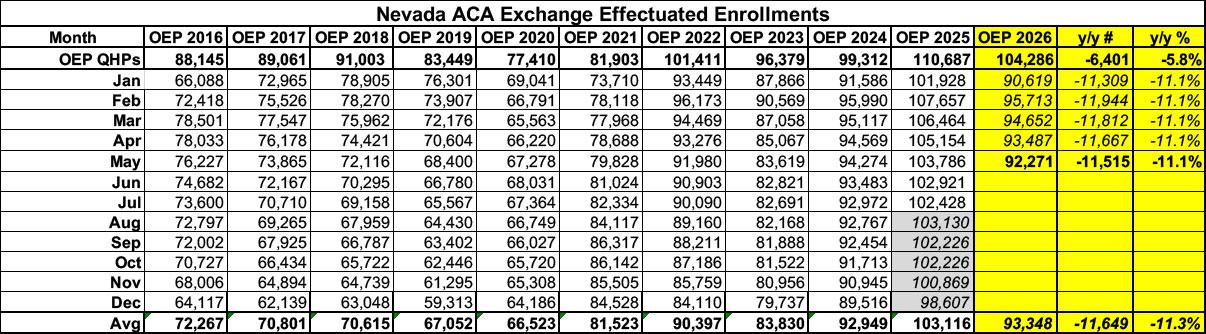
As of May, Nevada's effectuated enrollment stands at 92,271 people, down over 11% vs the same point a year earlier.
Nevada became the third state to launch what they call a "state public option" this year, which they've branded as "Battle Born State Plans" for whatever reason:
I last wrote about Nevada's initiative four years ago; at the time it really was supposed to be a true Public Option (that is, a major medical healthcare plan administered by the state itself which anyone could buy into at a more competitive price than private plans).
Unfortunately, since then the program has ended up being watered down quite a bit:
Nevadans looking for health insurance on the state’s Affordable Care Act marketplace this fall have a new, more budget-friendly option to review: Battle Born State Plans.
...Approximately 35,000 people are projected to purchase the Battle Born Plans, a number that could vary given rising health care costs and the expiration of certain federal subsidies.
Basically, like in WA & CO, the state contracted with several private insurance carriers to create a new category of ACA-compliant Qualified Health Plans (QHPs) to sell on the exchange. They have to meet the same requirements as any other exchange plan, except that they're legally required to hit certain premium reduction targets. That's pretty much the only distinction besides the branding.
...Insurance carriers offering the plans are required to align their networks with Medicaid managed care networks to ensure sufficient access to care.
...Under Nevada law, carriers offering the new state plans must satisfy premium reduction targets over the next four years, finishing at 15 percent lower than the average premium on the market.
So far it doesn't look like the new "Battle Born" plans are having much of an impact, at least on overall enrollment; I'll see whether they're helping reduce net premiums or other enrollee expenses soon when I get to Nevada in my state-by-state total cost project.
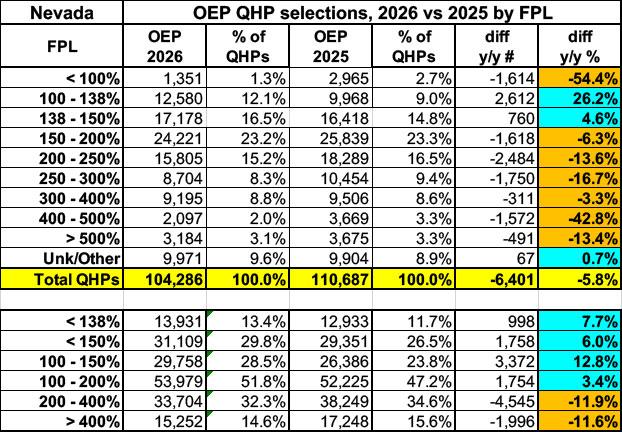
Here's the breakout of Open Enrollment Period (OEP) plan selections by income bracket. As with most other states, enrollment below the poverty line (which was always nominal to begin with) has been cut in half, and every other income bracket also saw enrollment plummet except for the 100 - 150% range...specifically the 100 - 138% range. I'm guessing that a lot of that is due to U.S. citizens who normally earn less than 100% FPL scrambling to nudge their official MAGI income over the 100% threshold in order to qualify for federal tax credits by taking on extra shifts at work, a second job, etc:
Here's the breakout by metal level, both unadjusted as well as adjusted by Cost Sharing Reduction (CSR) category. I should note that for the latter (grey cells in the 2nd table), I'm basing this on the average breakout of CSR categories across the 21 states which a) the Centers for Medicare & Medicaid Services (CMS) has provided hard data for and b) which have expanded Medicaid under the ACA:
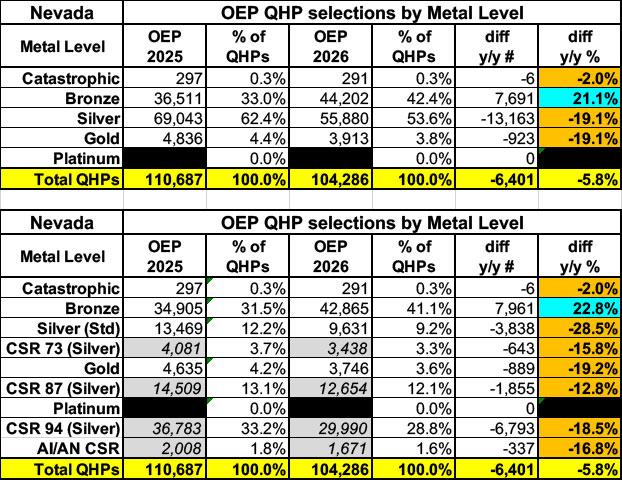
As is the case with most states, there's been a dramatic shift as enrollees "bought down" from Gold and Silver plans to Bronze plans with sky-high deductibles in order to mitigate the massive premium hikes this year.
Here's what effectuated enrollment will look like for the rest of the year in Nevada assuming it follows either the 2025 or 2019 patterns:
- If the rest of the year follows the 2025 pattern, effectuations will end December at around 88,000 and will average around 92,000 for the year...down 11.1% compared to 2025.
- If the rest of the year follows the 2019 pattern, effectuations will be at around 80,000 by December, and the average for the year will be around 88,000...down 14% y/y. That would mean more than 14,000 fewer people having ACA healthcare coverage than last year.
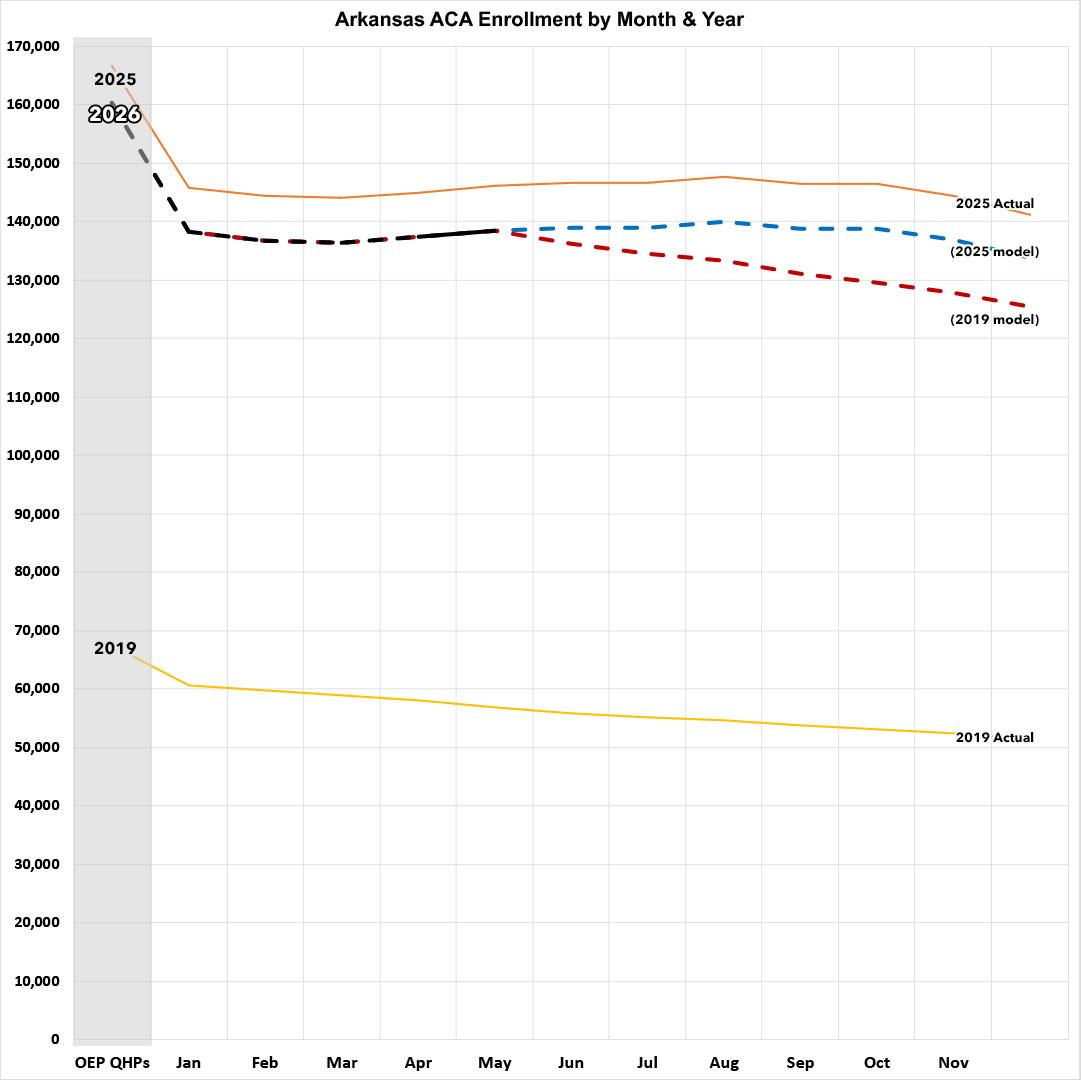
Here's where things stand so far...
- Arkansas: OEP down 3.8%; May effectuations down 5.3%
- California: OEP down 2.6%; February effectuations down 8.5%
- Colorado: OEP down 1.9%; March effectuations down 6.1%
- Georgia: OEP down 12.3%; April effectuations down 28.1%
- Maryland: OEP up 3.4%; April effectuations down 6.3%
- Massachusetts: OEP up 3.7%; April effectuations down 4.3%
- Minnesota: OEP down 8.1%; February effectuations down 8.6%
- Nevada: OEP down 5.8%; May effectuations down 11.1%
- New Jersey: OEP down 0.8%; April effectuations down 11.6%
- New Mexico: OEP up 18.1%; May effectuations up 5.6%
- New York: OEP down 4.9%; May effectuations down 8.7%
- Pennsylvania: OEP up 1%; May effectuations down 5.2%
- Washington: OEP down 5.9%; February effectuations down 15.7%
In terms of year over year average monthly effectuated enrollment as of the months of the latest data:
- Arkansas: Down ~7,700
- California: Down ~110,000
- Colorado: Down ~13,400
- Georgia: Down ~370,000
- Maryland: Up ~7,000
- Massachusetts: Up ~1,600
- Minnesota: Down ~10,000
- Nevada: Down ~11,500
- New Jersey: Down ~57,000
- New York: Down ~14,500
- New Mexico: Up ~7,200
- Pennsylvania: Down ~2,300
- Washington: Down ~33,000
- Total across 13 states: Down at least 613,000
Advertisement


