


2027 Rate Changes - Hawaii: +12.7% indy mkt; enrollment down 9% y/y (FINAL)
Thu, 09/17/2026 - 8:59am
Originally posted on 7/30/26
Before I begin, it's important to note that ACA exchange enrollment has dropped in Hawaii since Congressional Republicans allowed the enhanced federal subsidies to expire at the end of last year. Fortunately, the raw number of enrollees who have lost coverage is pretty small due to:
- a) Hawaii only having around 1.4 million residents to begin with and
- b) Hawaii having a much more robust Employer-Sponsored Health Insurance mandate law than the ACA. Under the Hawaii Prepaid Health Care Act of 1974, employers are required to offer coverage to employees working at least 20 hours per week. In contrast, the federal Patient Protection and Affordable Care Act requires employers to offer coverage to employees working at least 30 hours per week.
As a result, Hawaii's individual/nongroup health insurance market is smaller as a percentage of the total population than it is in most other states.
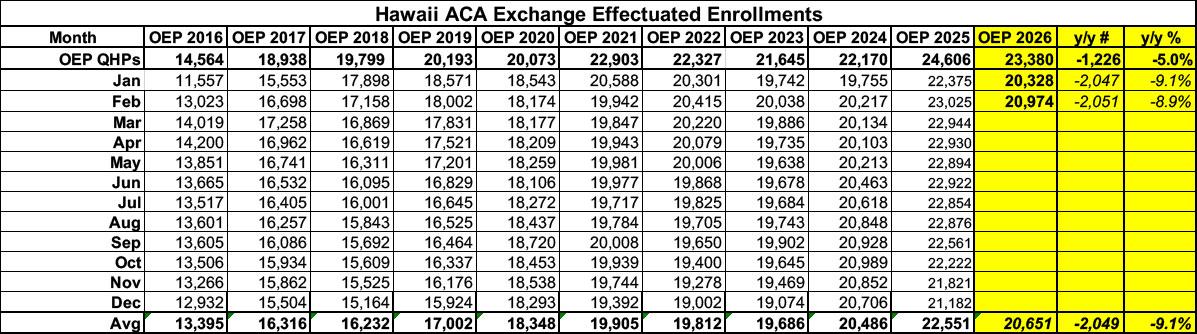
Initial signups during Open Enrollment were "only" down 5% vs. OEP 2025...but effectuated enrollment was down over 9% in January and February, down over 2,000 enrollees vs. the same month a year earlier.
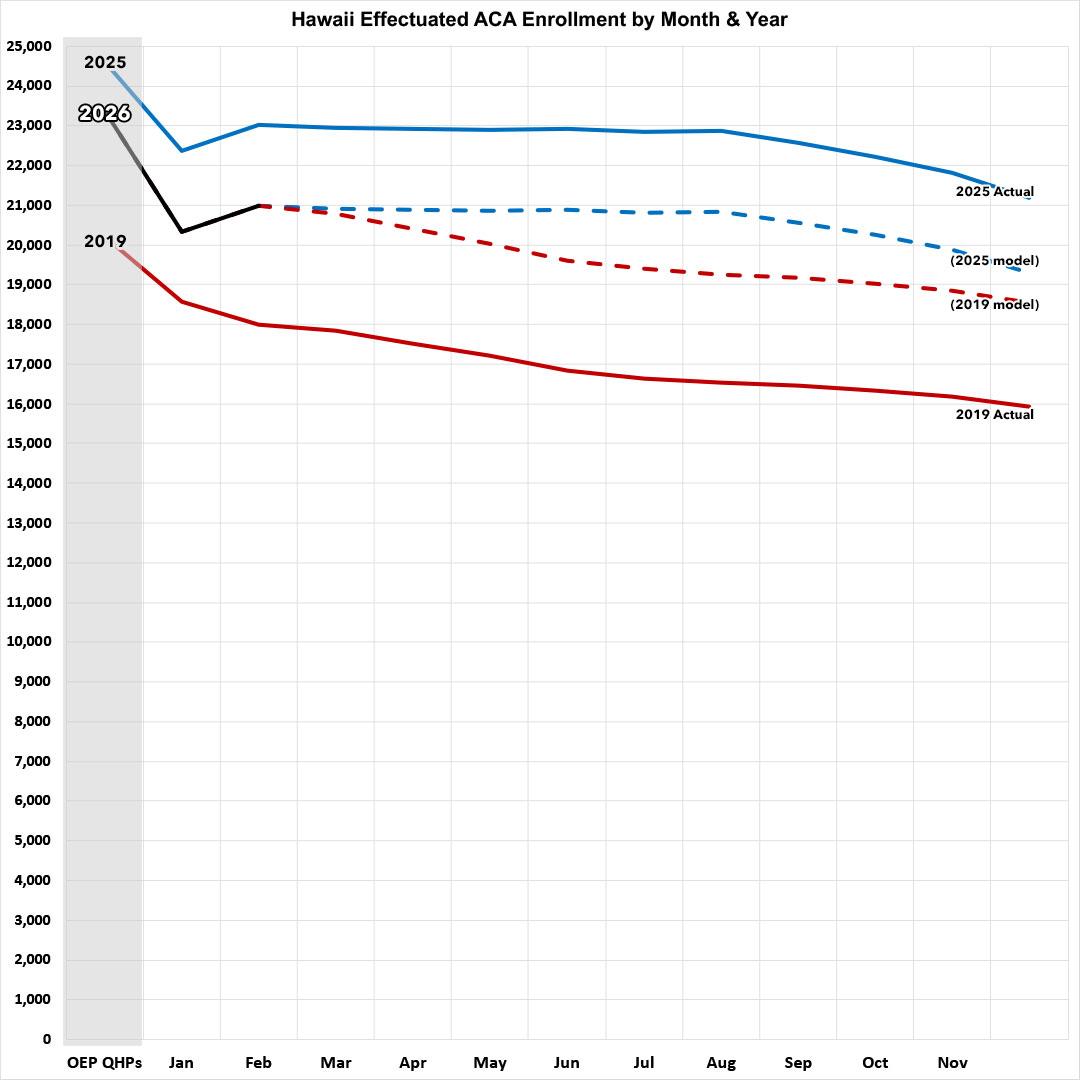
Here's what this looks like visually, with both 2025 and 2019 (the last pre-COVID year, which didn't include the enhanced subsidies) included for comparison:
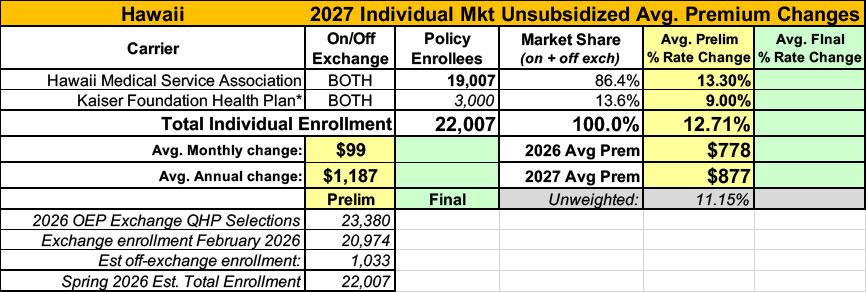
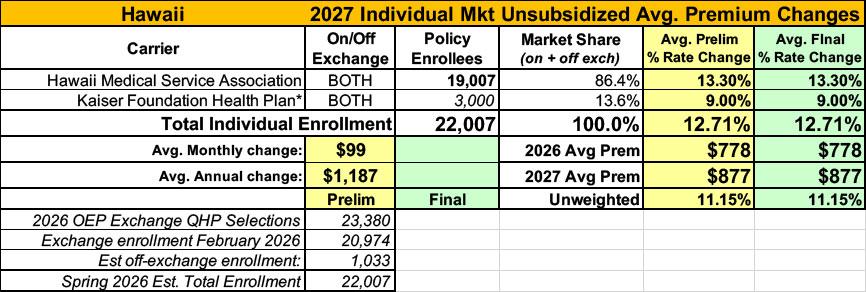
Looking ahead to 2027, the preliminary rate filings for both the individual and small group markets are now available via the Hawaii SERFF (System for Electronic Rates & Forms Filing) database. I had to estimate the number of effectuated enrollees as of spring 2026 for Kaiser Foundation Health Plan based on the total effectuated exchange enrollment as of February (~21,000) and the actual number of Hawaii Medical Service Association enrollees (~19,000):
Hawaii Medical Service Association:
PART II RATE INCREASE JUSTIFICATION
Hawaii Medical Service Association Affordable Care Act Individual Policies in Hawaii Effective January 1, 2027
Our requested rates include only the amounts needed to cover the expected health care benefits of our members, the cost of administering their benefits, expected Affordable Care Act (ACA) fees, and a small charge to help manage the risk of offering benefits to this population.
We based our rate increase request on a review of past costs of benefits and other expenses. These historical costs are adjusted for trend, to account for expected changes in use of medical services, cost inflation, and other factors that affect the cost of care. We also adjusted costs for benefit changes, which were largely made to comply with government mandated plan designs. There is an administrative expense increase due to an internal reallocation of expenses across lines of business as well as membership deterioration in non-ACA lines of business.
The overall requested rate increase for our plans is 13.3%. The increases range from a low of 2.1% for the Bronze PPO II HSA plan to a high of 15.4% for the Platinum PPO plan. The Platinum PPO plan and the Gold PPO II are the only plans exceeding a 15% increase. There are 19,007 members, including 528 Catastrophic plan members, enrolled in our ACA Individual plans as of March 2026.
HMSA has had moderate rate increases for ACA Individual plans over the past several years. From 2022 to 2026, we managed to keep the average annual rate increase to 7.6%.
We understand that any rate increase creates hardship for some members. However, the increase is necessary to keep up with the costs of covering this population and ensure the plan remains viable in the future. HMSA expects to offer plans in all metallic levels (Bronze, Silver, Gold, Platinum). The Catastrophic Plan will be discontinued at the end of 2026.
...The reasons for the rate changes are as follows:
- to reflect HMSA’s recent 2025 individual plan experience and the change from the average morbidity and demographics in these plans in 2025 to the morbidity and demographics expected of members in ACA compliant plans only in 2027, including the impact of the expiration of enhanced premium tax credits;
- to reflect benefit and Actuarial Value (AV) changes;
- to reflect trend from 2025 to 2027, both unit cost and utilization;
- to reflect changes in risk adjustment transfer projections;
- to reflect updated costs of other Essential Health Benefit (EHB) and non-EHB cost items, including vision, routine non-pediatric adult dental, quality improvement, medical management, and other retention; and
- to reflect changes to HMSA’s administrative fees or loads, as well as to the Exchange and other ACA fees.
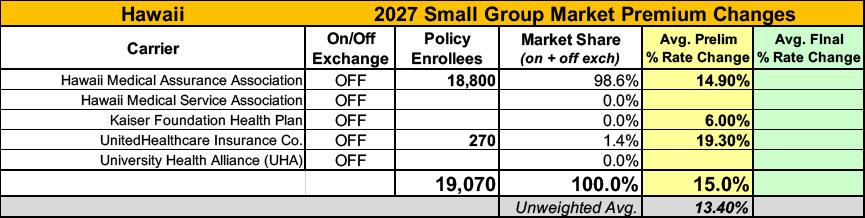
For Hawaii's small group market, I was only able to find the actual rate change requests for three of the five carriers; it's possible that the other two (HMSA and University Health Alliance) are pulling out of the market next year, although that seems unlikely given the state employer coverage mandate. In any event, this means that even my unweighted average of 13.4% is incomplete, which is why I'm not mentioning it in the headline above:
UPDATE 9/17/26: The final, approved rate filings for Hawaii's 2027 individual market carriers have been published; it looks like they were both approved exactly as submitted. I don't know about the small group market, however.
Advertisement


